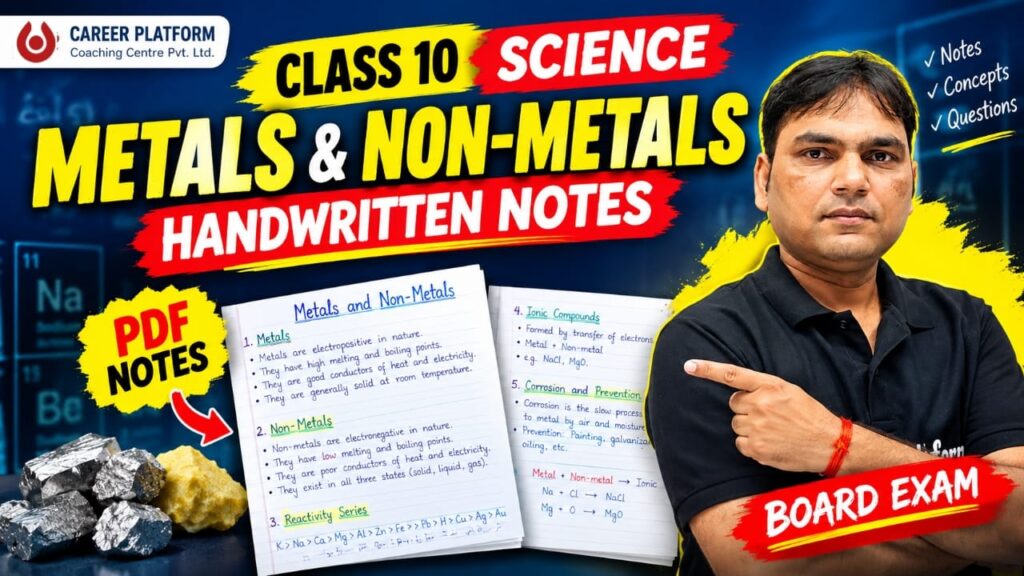
Class 10 Science Chapter 3 Metals and Non-Metals Handwritten Notes PDF by Binod Sir
Are you preparing for the Class 10 Science Board Examination 2027 and looking for easy-to-understand Metals and Non-Metals handwritten notes PDF? Career Platform Coaching Centre brings you teacher-prepared study notes and chapter discussion by Binod Sir to help students understand important concepts, revise chemical reactions and practice examination-style questions.
The chapter Metals and Non-Metals is an important part of Class 10 Chemistry. Students should understand the physical and chemical properties of metals and non-metals, the reactivity series, ionic compounds, basic metallurgical processes, and corrosion and its prevention.
Students preparing for CBSE, State Board, NIOS and other relevant Class 10 examinations can use these notes as a revision resource alongside their prescribed textbooks and official syllabus.
Download Class 10 Metals and Non-Metals Handwritten Notes PDF
Students can use the handwritten notes prepared by Binod Sir for chapter revision and question practice.
Study resource details:
- Class: 10
- Subject: Science
- Chapter: Metals and Non-Metals
- Resource: Teacher-prepared handwritten notes
- Faculty: Binod Sir
- Institute: Career Platform Coaching Centre Pvt. Ltd.
- Useful for: Concept revision, written practice and board exam preparation
PDF Download Link
Click below to access the handwritten notes PDF:
👉 Download Metals and Non-Metals Handwritten Notes PDF
https://drive.google.com/file/d/1BCbd4p2FRiATVMi1Ed8dbGIRyEszLzwS/view?usp=sharing
https://drive.google.com/file/d/1hHsLvSHCf8o14XgzCWyyK1hiOeFiO1-j/view?usp=sharing
Note: Replace the placeholder above with the actual PDF URL before publishing this article.
Watch the Complete Chapter Discussion by Binod Sir
Reading notes is useful, but understanding the concepts behind each reaction is equally important. Watch the Class 10 Science Metals and Non-Metals chapter discussion on the Career Platform CBSE YouTube channel.
In the video, students can follow the explanation, revise key concepts and practice relevant questions from the chapter.
👉 Watch the YouTube Video: Metals and Non-Metals Class 10 | Handwritten Notes and Important Questions
Subscribe to Career Platform CBSE for more educational videos, chapter revision, study resources and board examination preparation guidance.
What Will You Learn in the Metals and Non-Metals Chapter?
1. Physical Properties of Metals and Non-Metals
Metals generally have properties such as lustre, malleability, ductility, sonority and good conductivity of heat and electricity. Non-metals generally show contrasting properties.
Students should also learn important exceptions. For example, mercury is a liquid metal at room temperature, while graphite is a non-metal that conducts electricity.
2. Chemical Properties of Metals
Metals react with different substances under suitable conditions. Students should understand the reactions of metals with oxygen, water, dilute acids and salt solutions, wherever included in their prescribed syllabus.
For example:
Reaction of magnesium with oxygen:
2Mg + O₂ → 2MgO
Magnesium reacts with oxygen to form magnesium oxide.
Reaction of zinc with dilute hydrochloric acid:
Zn + 2HCl → ZnCl₂ + H₂
Zinc reacts with dilute hydrochloric acid to produce zinc chloride and hydrogen gas.
Practice balancing equations and identifying the products of reactions.
3. Reactivity Series
The reactivity series arranges metals in decreasing order of their chemical reactivity.
A commonly taught series is:
K > Na > Ca > Mg > Al > Zn > Fe > Pb > H > Cu > Hg > Ag > Au
The position of a metal helps students predict whether it can displace another metal from its salt solution.
For example, zinc can displace copper from copper sulphate solution because zinc is more reactive than copper.
Zn + CuSO₄ → ZnSO₄ + Cu
Students should understand the reasoning behind displacement reactions rather than memorising the series alone.
4. Formation and Properties of Ionic Compounds
Ionic compounds are formed through the transfer of electrons, resulting in positively and negatively charged ions that attract one another.
For example, sodium chloride (NaCl) contains sodium ions (Na⁺) and chloride ions (Cl⁻).
Important properties to revise include:
- Ionic compounds are generally solid at room temperature.
- They usually have high melting and boiling points.
- They conduct electricity in the molten state or in aqueous solution when mobile ions are present.
- They are often soluble in water, although solubility varies between compounds.
5. Basic Metallurgical Processes
Metallurgy involves obtaining metals from their ores and refining them for use.
Revise the main stages relevant to your syllabus, including concentration of ore, extraction of the metal and refining. Learn how the extraction method depends on the reactivity of the metal.
6. Corrosion and Its Prevention
Corrosion is the gradual deterioration of a metal due to reactions with its environment.
Rusting is the corrosion of iron in the presence of oxygen and moisture.
Common prevention methods include painting, oiling, greasing, galvanization and suitable protective coatings.
Students should be able to explain why these methods help protect metals.
Important Questions for Class 10 Science Board Exam
Practice the following questions after studying the handwritten notes.
- Differentiate between metals and non-metals on the basis of physical properties.
- Why is sodium stored in kerosene?
- What happens when a more reactive metal is placed in the salt solution of a less reactive metal?
- Explain the formation of sodium chloride using electron transfer.
- Why do ionic compounds generally have high melting points?
- Why do ionic compounds conduct electricity in the molten state?
- What is corrosion? Mention methods of preventing it.
- Explain why metals are used for making electrical wires.
- Write a balanced chemical equation for the reaction of zinc with dilute hydrochloric acid.
- What is the reactivity series, and how is it useful in predicting displacement reactions?
These are practice questions for revision, not predictions or guarantees of the questions that will appear in the examination. Students should also solve prescribed textbook exercises, sample papers and relevant previous-year questions.
How to Prepare This Chapter Effectively
Follow this study sequence for better revision:
Step 1: Understand the concepts. Read the chapter from your prescribed textbook and identify unfamiliar terms.
Step 2: Study the handwritten notes. Use Binod Sir’s notes to revise definitions, reactions, properties and key points.
Step 3: Practise chemical equations. Write equations yourself and check whether they are balanced.
Step 4: Solve questions in writing. Practise short answers, explanations, chemical reactions and multiple-choice questions.
Step 5: Test your preparation. Attempt a chapter test without looking at the notes, then correct your mistakes.
Step 6: Revise regularly. Revisit the reactivity series, ionic compounds and corrosion after a few days.
Who Can Use These Study Notes?
These notes are intended as a supplementary revision resource for:
- CBSE Class 10 Science students
- State Board Class 10 students studying equivalent topics
- NIOS Secondary Science students, where the topics match their course syllabus
- Students who need additional concept revision and question practice
Syllabus coverage, chapter numbering and examination requirements may differ between boards. Always follow the official syllabus and prescribed textbook applicable to your examination session.
About Career Platform Coaching Centre
Career Platform Coaching Centre Pvt. Ltd. provides educational guidance and learning resources for students preparing for school examinations and competitive examinations.
Through the Career Platform CBSE YouTube channel, students can access educational videos, chapter discussions, revision guidance and study resources.
Faculty: Binod Sir
Website: https://careerplatform.in
YouTube Channel: Career Platform CBSE — insert the actual channel link here.
Frequently Asked Questions
1. Where can I download Class 10 Metals and Non-Metals handwritten notes PDF?
Use the PDF download link provided near the beginning of this article. The website owner must add the actual working PDF URL before publishing.
2. Who prepared these handwritten notes?
The notes are presented as teacher-prepared study material by Binod Sir from Career Platform Coaching Centre.
3. Are these notes useful for CBSE Board Exam 2027?
They can support chapter revision and question practice. Students should compare the content with the official CBSE 2026–27 syllabus and prescribed textbook.
4. Can State Board and NIOS students use these notes?
Students can use the notes for topics that match their respective course syllabus. They should check their board-specific requirements before relying on any supplementary resource.
5. Will the exact questions from these notes appear in the board examination?
No one can guarantee that specific questions will appear in the examination. The purpose of the notes is to help students understand concepts and practise relevant question types.
Conclusion
Class 10 Science Chapter 3, Metals and Non-Metals, becomes easier to revise when students combine textbook learning, handwritten notes, chemical equation practice and regular testing.
Download the notes using the link provided, watch the chapter discussion by Binod Sir on Career Platform CBSE, and practise the questions independently. Consistent revision and a clear understanding of the concepts can help you prepare more confidently for your board examination.
Career Platform Coaching Centre Pvt. Ltd.
Building Concepts, Creating Futures.

Pingback: Class 10 Light Reflection & Refraction Notes PDF | Binod Sir - Career Platform