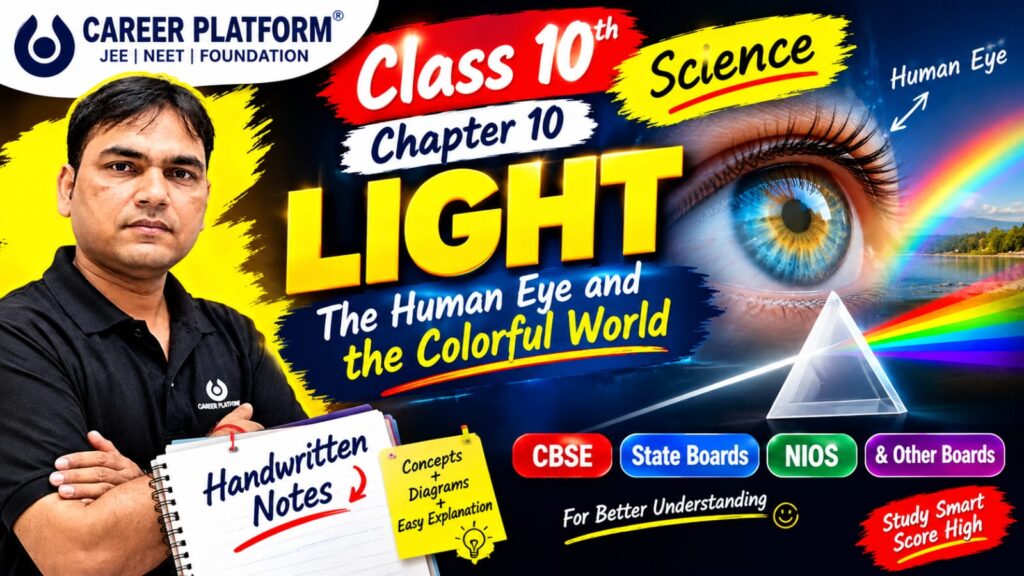
Human Eye and The Colourful World Class 10 Science Notes | CBSE 2027
Are you preparing for the CBSE Class 10 Science Board Exam 2027? The chapter The Human Eye and the Colourful World explains how our eyes help us see objects, how common vision defects are corrected, and why natural phenomena such as the blue colour of the sky and the twinkling of stars occur.
In this article, Career Platform CBSE brings you easy revision notes, important definitions, key concepts, and practice MCQs to help you revise this chapter effectively.
These notes cover the main topics prescribed in the CBSE Science syllabus for the 2026–27 academic session. Students should also practice textbook questions, labelled diagrams, and previous practice questions.
Human Eye and The Colourful World: Chapter Overview
The human eye is a natural optical instrument. It receives light from objects and forms images that allow us to see our surroundings.
The chapter covers the following topics:
- Structure and functioning of the human eye
- Power of accommodation
- Defects of vision and their correction
- Refraction of light through a glass prism
- Dispersion of white light
- Atmospheric refraction
- Scattering of light and its applications
1. Structure and Functioning of the Human Eye
The human eye works in a way similar to a camera. It focuses incoming light to form an image on a light-sensitive surface called the retina.
Important Parts of the Human Eye
Cornea: The transparent front surface of the eye through which light enters. It provides much of the refraction needed to focus light.
Iris: The coloured part of the eye that controls the size of the pupil.
Pupil: The opening through which light enters the eye. Its size changes according to the intensity of light.
Eye Lens: A transparent, flexible convex lens that helps focus light on the retina.
Ciliary Muscles: These muscles change the curvature and focal length of the eye lens to focus on objects at different distances.
Retina: The light-sensitive layer on which a real, inverted image is formed.
Optic Nerve: It carries visual signals from the retina to the brain.
How Does the Human Eye Work?
Light enters through the cornea and pupil. The eye lens focuses the light onto the retina. Light-sensitive cells in the retina convert it into electrical signals, which travel through the optic nerve to the brain. The brain processes these signals and enables us to see.
2. Power of Accommodation
The ability of the eye lens to change its focal length so that objects at different distances can be seen clearly is called the power of accommodation.
For a normal human eye:
- The near point is approximately 25 cm.
- The far point is at infinity.
- Ciliary muscles help change the focal length of the eye lens.
When viewing a nearby object, the eye lens becomes thicker and its focal length decreases. When viewing a distant object, the lens becomes thinner and its focal length increases.
3. Defects of Vision and Their Correction
Sometimes the eye cannot form a clear image on the retina. This condition is called a defect of vision.
Myopia (Short-Sightedness)
A person with myopia can see nearby objects clearly but has difficulty seeing distant objects.
Causes:
- The eyeball may be elongated.
- The eye lens may have excessive converging power.
Correction: Myopia is corrected using a concave lens of suitable power. The lens diverges incoming light so that the eye can focus the image on the retina.
Hypermetropia (Long-Sightedness)
A person with hypermetropia can see distant objects clearly but has difficulty seeing nearby objects.
Causes:
- The eyeball may be shorter than normal.
- The eye lens may have insufficient converging power.
Correction: Hypermetropia is corrected using a convex lens of suitable power.
Presbyopia
Presbyopia is an age-related defect in which the eye gradually loses its ability to focus on nearby objects. It is associated with reduced flexibility of the eye lens and changes in the ciliary muscles.
It may be corrected using suitable convex lenses. Bifocal or progressive lenses may be prescribed when a person needs correction for both near and distant vision.
4. Refraction of Light Through a Prism
A glass prism is a transparent optical object with two inclined refracting surfaces. When light passes through a prism, it changes direction due to refraction.
The emergent ray is generally deviated from its original direction. The angle between the direction of the incident ray and the emergent ray is called the angle of deviation.
A prism can also separate white light into its constituent colours.
5. Dispersion of White Light
The splitting of white light into its constituent colours is called dispersion of light.
When white light passes through a glass prism, different colours refract by different amounts. The familiar sequence of colours is:
Violet, Indigo, Blue, Green, Yellow, Orange and Red (VIBGYOR).
Violet light deviates the most, while red light deviates the least in a typical glass prism.
A band of colours produced by dispersion is called a spectrum.
Rainbow Formation
A rainbow forms when sunlight interacts with water droplets in the atmosphere. Refraction, dispersion and internal reflection inside the droplets contribute to the formation of the coloured arc.
6. Atmospheric Refraction
Atmospheric refraction is the bending of light as it travels through different layers of the atmosphere. These layers have different optical densities because atmospheric conditions vary with height.
Twinkling of Stars
Stars are very far away and appear as point sources of light. As starlight passes through changing atmospheric layers, its apparent position and brightness fluctuate. This produces the twinkling effect.
Planets generally appear steadier because they appear as extended sources rather than point sources.
7. Scattering of Light
Scattering occurs when light interacts with particles in a medium and is redirected in different directions.
Why Does the Sky Appear Blue?
Molecules in the atmosphere scatter shorter wavelengths of visible light more strongly than longer wavelengths. Blue light is scattered significantly, making the sky appear blue when viewed away from the Sun under ordinary clear-sky conditions.
Tyndall Effect
The Tyndall effect is the scattering of light by colloidal particles. It makes the path of a light beam visible when the beam passes through a suitable colloid or fine suspension.
For example, a beam of sunlight may become visible in a room containing dust particles.
8. Important Differences for Exams
Myopia vs Hypermetropia
| Myopia | Hypermetropia |
|---|---|
| Nearby objects are clear. | Distant objects are generally clear. |
| Distant objects appear blurred. | Nearby objects appear blurred. |
| Image of a distant object forms in front of the retina. | Image of a nearby object would form behind the retina. |
| Corrected using a concave lens. | Corrected using a convex lens. |
Dispersion vs Scattering
| Dispersion | Scattering |
|---|---|
| White light separates into different colours. | Light is redirected by particles. |
| A glass prism can produce a spectrum. | Atmospheric molecules scatter sunlight. |
| Different wavelengths refract by different amounts. | The amount of scattering depends on wavelength and particle properties. |
9. Important Points to Remember
- The retina is the light-sensitive surface of the eye.
- The iris controls the size of the pupil.
- The eye lens changes focal length through accommodation.
- A concave lens corrects myopia.
- A convex lens corrects hypermetropia.
- Dispersion separates white light into its constituent colours.
- Violet deviates more than red in a typical glass prism.
- Atmospheric refraction explains the twinkling of stars.
- Scattering of shorter visible wavelengths contributes to the blue colour of the sky.
- The Tyndall effect is associated with scattering by colloidal particles.
10. Class 10 Science Chapter 10: Practice MCQs
Test your understanding with these multiple-choice questions.
Q1. Which part of the eye controls the size of the pupil?
A. Retina
B. Iris
C. Optic nerve
D. Eye lens
Correct Answer: B. Iris
Q2. Which lens is used to correct myopia?
A. Convex lens
B. Concave lens
C. Plane glass
D. Prism
Correct Answer: B. Concave lens
Q3. What is the splitting of white light into its constituent colours called?
A. Reflection
B. Scattering
C. Dispersion
D. Absorption
Correct Answer: C. Dispersion
Q4. Why do stars appear to twinkle?
A. Reflection from the Moon
B. Atmospheric refraction
C. Dispersion through a prism
D. Scattering by clouds only
Correct Answer: B. Atmospheric refraction
Q5. Which phenomenon is mainly responsible for the blue appearance of the clear sky?
A. Reflection
B. Scattering of light
C. Total internal reflection
D. Absorption of blue light
Correct Answer: B. Scattering of light
11. How to Prepare This Chapter for CBSE 2027
Follow these revision steps to strengthen your understanding:
- Learn the functions of the important parts of the human eye.
- Practise diagrams showing myopia and hypermetropia and their correction.
- Understand how a prism refracts and disperses white light.
- Revise the reasons behind the twinkling of stars and the blue appearance of the sky.
- Practise textbook questions and MCQs without looking at the answers first.
- Review the official syllabus and your prescribed textbook before the examination.
Do not rely only on memorising definitions. Understanding the reasons behind each phenomenon will help you answer conceptual and application-based questions.
Conclusion
The chapter The Human Eye and the Colourful World connects the science of light with everyday experiences. Understanding the functioning of the eye, defects of vision, dispersion, atmospheric refraction and scattering can make revision easier and more effective.
Revise regularly, practise diagrams, and test your understanding with MCQs as part of your CBSE Class 10 Science Board Exam 2027 preparation.
For more chapter-wise notes, practice questions and study updates, visit Career Platform CBSE.
Study Resources: https://blog.careerplatform.in/
Human Eye and The Colourful World Class 10 Science Notes
Download PDF Notes for Class 10 Science CBSE Board Exam 2027:
https://drive.google.com/file/d/1ZStqe04mz_sD7yQ0H_FEGq1dLD6NvRK5/view?usp=sharing
Pingback: Class 10 Carbon & Its Compounds | Handwritten Notes PDF