JEE Main 2027 Registration Advisory: NTA Issues DigiLocker Re-KYC Instructions
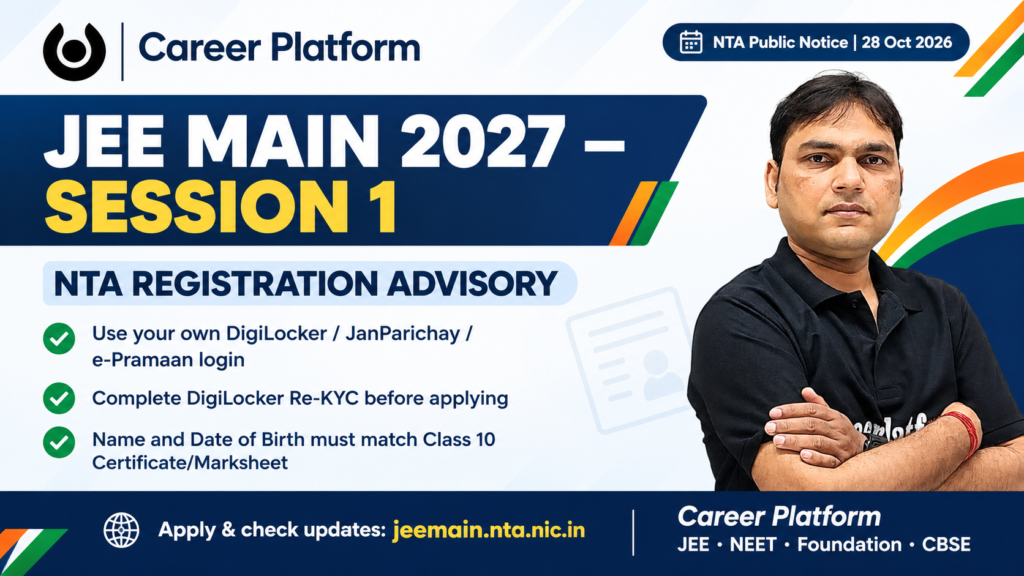
The National Testing Agency (NTA) has issued an important public notice dated 28 October 2026 regarding the registration process for Joint Entrance Examination (JEE) Main 2027 Session 1. The advisory provides instructions on digital identity credentials, DigiLocker Re-KYC and matching personal details with Class 10 records.
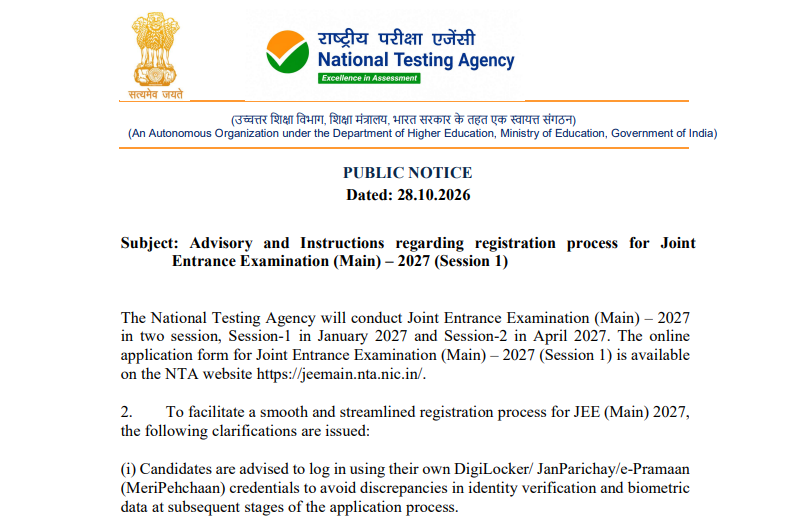
Candidates preparing to apply for JEE Main 2027 should read these instructions carefully before completing their application form. Using their own login credentials, updating their digital identity details and checking their academic records can help reduce discrepancies during registration and subsequent identity verification.
Candidates can access the official application portal and notices at jeemain.nta.nic.in.
JEE Main 2027 Latest Update: Highlights of NTA’s Advisory
According to the NTA public notice dated 28 October 2026, candidates should pay attention to these three key instructions:
- Use your own login credentials: Candidates are advised to use their own DigiLocker, JanParichay or e-Pramaan (MeriPehchaan) credentials.
- Complete DigiLocker Re-KYC: NTA advises candidates to complete Re-KYC through DigiLocker before filling out the online application form.
- Match name and date of birth: The name and date of birth entered in the application form must match the details on the Class 10 certificate or marksheet.
NTA has issued these clarifications to facilitate a smooth registration process and help avoid discrepancies in identity verification and biometric data at later stages.
1. Use Your Own DigiLocker, JanParichay or e-Pramaan Login
NTA advises candidates to log in using their own credentials for one of the designated digital identity services:
- DigiLocker
- JanParichay
- e-Pramaan (MeriPehchaan)
Candidates should ensure that they use their own accounts rather than another person’s credentials. According to the notice, this is intended to help avoid discrepancies during identity verification and biometric data checks at subsequent stages of the application process.
Before starting registration, check that you can access your selected account and that the information associated with it is up to date.
2. Complete DigiLocker Re-KYC Before Filling Out the Form
Another important instruction in the advisory is to complete Re-KYC through DigiLocker before filling out the JEE Main 2027 online application form.
NTA has advised candidates to complete this process so that their latest details can be fetched during registration.
Candidates should therefore:
- Access their own DigiLocker account.
- Check their available identity information and documents.
- Complete the applicable Re-KYC process through DigiLocker.
- Follow the instructions provided by the official platform.
- Proceed to the JEE Main application portal and carefully enter the required details.
These points are a preparation checklist, not a substitute for the official Re-KYC procedure. Follow the current on-screen instructions on DigiLocker and the official JEE Main portal.
Important: Do not assume that creating a new account automatically completes Re-KYC. Check the verification status and follow the platform’s instructions.
3. Name and Date of Birth Must Match the Class 10 Certificate
NTA has specifically clarified that the candidate’s name and date of birth in the JEE Main 2027 application form must be the same as those mentioned in the Class 10 certificate or marksheet.
This is an important point to check before submitting the application.
Candidates should compare the following details:
| Detail | What to check |
|---|---|
| Candidate’s name | Match the Class 10 certificate or marksheet |
| Date of birth | Match the Class 10 certificate or marksheet |
| Digital identity details | Check that the latest information is available |
| Application form | Review the entered information before submission |
If you notice a discrepancy, do not guess which information to enter. Consult the official instructions and contact the examination authority through its published support channels if clarification is required.
Candidates should also avoid making unnecessary changes to identity information without understanding the applicable official procedure.
4. JEE Main 2027 Exam Sessions
The NTA notice states that JEE Main 2027 will be conducted in two sessions.
| Particulars | Schedule |
|---|---|
| JEE Main 2027 Session 1 | January 2027 |
| JEE Main 2027 Session 2 | April 2027 |
| Official website | jeemain.nta.nic.in |
Candidates should visit the official website regularly for detailed examination schedules, application instructions, correction-window information, admit cards and other announcements.
Always verify specific dates and deadlines against the latest official notification before taking action.
5. JEE Main 2027 Registration: Checklist Before Applying
Use this checklist to prepare for the registration process.
- I can access my own DigiLocker, JanParichay or e-Pramaan credentials.
-
I have checked my digital identity details.
-
I have completed the applicable DigiLocker Re-KYC process.
-
I have checked my name against my Class 10 certificate or marksheet.
-
I have checked my date of birth against my Class 10 certificate or marksheet.
-
I have reviewed the latest instructions on the official JEE Main website.
-
I will review the application details carefully before final submission.
This checklist summarises the main points of the 28 October advisory. It does not replace the complete application instructions or other document requirements published by NTA.
6. Where to Check Official JEE Main 2027 Updates
Candidates should rely on official NTA announcements for registration instructions and examination-related updates.
Official website: https://jeemain.nta.nic.in/
Regularly check the website for:
- JEE Main 2027 Session 1 application information
- Public notices and registration advisories
- Application correction instructions
- Examination schedules and city information
- Admit cards and other examination updates
Do not rely exclusively on social media posts or unofficial summaries when checking important deadlines or application requirements.
Conclusion
The NTA public notice dated 28 October 2026 highlights three important points for JEE Main 2027 Session 1 registration: use your own digital identity credentials, complete DigiLocker Re-KYC before filling out the form, and ensure that your name and date of birth match your Class 10 certificate or marksheet.
Candidates should complete these checks carefully and continue monitoring the official NTA website for further instructions.
For more JEE Main, NEET, Foundation and CBSE updates, follow Career Platform JEE.


Pingback: JEE Main 2027 Registration: Last Date, Exam Date & Pattern - Career Platform