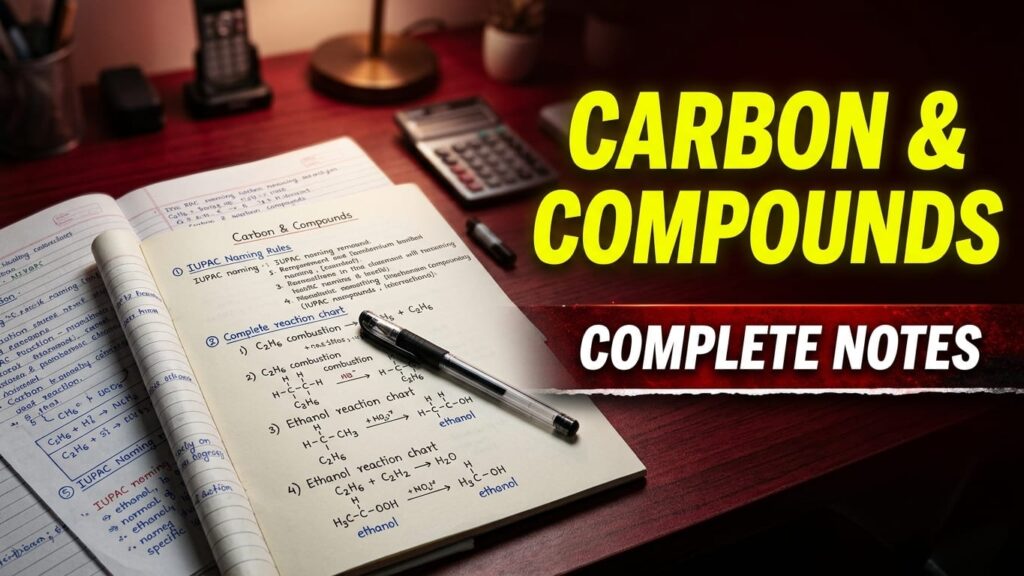
Carbon and Its Compounds Class 10: Handwritten Notes PDF
Carbon and Its Compounds Class 10 Science is an important chapter for students preparing for the CBSE Board Examination 2027. This chapter explains the unique properties of carbon, covalent bonding, hydrocarbons, functional groups, chemical reactions, ethanol, ethanoic acid, soaps and detergents.
At Career Platform Coaching Centre, Binod Sir explains important concepts through simple explanations, handwritten notes and board-oriented questions to help students develop a strong understanding of Chemistry.
If you are preparing for CBSE Class 10, State Board or NIOS examinations, this article will help you revise the important topics of Carbon and Its Compounds.
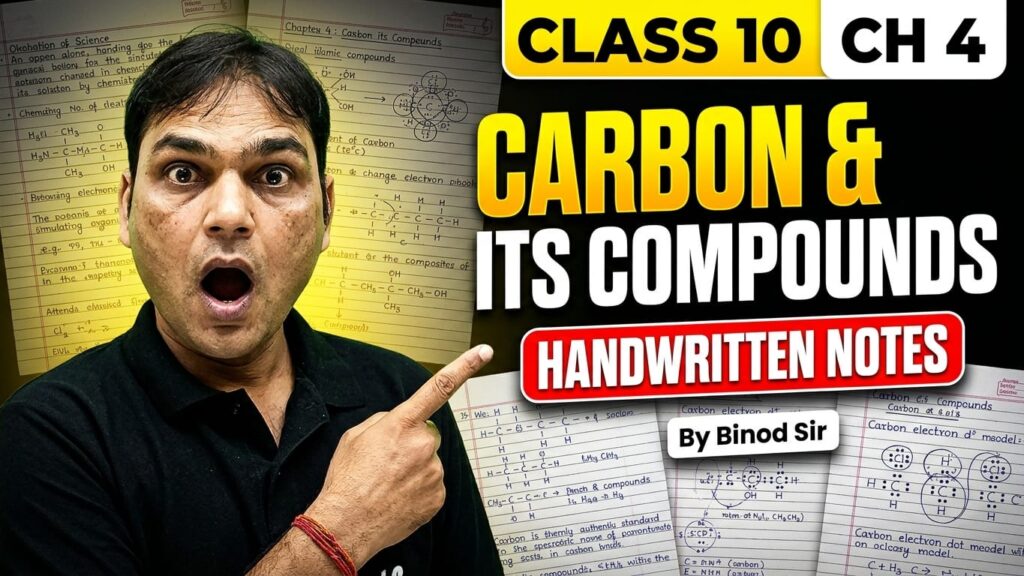
Class 10 Carbon & Its Compounds 🔥 Handwritten Notes PDF
https://drive.google.com/file/d/1K1aZfGYx2mt_BZCPUdmh4A4TePTlS_wM/view?usp=sharing
https://drive.google.com/file/d/1h2vwEZQvMgfPA1IRGT7x2vao3oIbyfit/view?usp=sharing
What Will You Learn in Carbon and Its Compounds?
The important topics covered in this chapter include:
- Bonding in Carbon – The Covalent Bond
- Versatile Nature of Carbon
- Saturated and Unsaturated Hydrocarbons
- Homologous Series
- Nomenclature of Carbon Compounds
- Functional Groups
- Chemical Properties of Carbon Compounds
- Ethanol and Ethanoic Acid
- Soaps and Detergents
Let’s understand these concepts one by one.
1. Bonding in Carbon – The Covalent Bond
Carbon has atomic number 6 and electronic configuration 2,4. It contains four electrons in its outermost shell.
Carbon needs four more electrons to complete its octet. Instead of gaining or losing four electrons, carbon generally shares electrons with other atoms to form covalent bonds.
A covalent bond is formed by the sharing of electron pairs between atoms.
Examples:
- Methane – CH₄
- Ethane – C₂H₆
- Ethene – C₂H₄
- Ethyne – C₂H₂
Important Board Question: Why does carbon form covalent bonds?
Answer: Carbon has four valence electrons. Losing or gaining four electrons is energetically difficult. Therefore, carbon completes its octet by sharing electrons and forming covalent bonds.
2. Versatile Nature of Carbon
Carbon forms a very large number of compounds because of two important properties.
A. Catenation
Catenation is the ability of carbon atoms to form bonds with other carbon atoms, producing long chains, branched chains and rings.
B. Tetravalency
Carbon has a valency of four. It can form four covalent bonds with carbon, hydrogen, oxygen, nitrogen and other elements.
These two properties are responsible for the enormous variety of carbon compounds.
Important Question: What are catenation and tetravalency?
3. Saturated and Unsaturated Hydrocarbons
Hydrocarbons are compounds made up of carbon and hydrogen only.
They are classified into two main categories.
Saturated Hydrocarbons
Saturated hydrocarbons contain only single covalent bonds between carbon atoms. They are called alkanes.
General formula: CₙH₂ₙ₊₂
Examples:
- Methane – CH₄
- Ethane – C₂H₆
- Propane – C₃H₈
Unsaturated Hydrocarbons
Unsaturated hydrocarbons contain double or triple bonds between carbon atoms.
Alkenes: Contain at least one carbon-carbon double bond.
General formula for open-chain alkenes with one double bond: CₙH₂ₙ.
Example: Ethene – C₂H₄.
Alkynes: Contain at least one carbon-carbon triple bond.
General formula for open-chain alkynes with one triple bond: CₙH₂ₙ₋₂.
Example: Ethyne – C₂H₂.
Important Board Question: Differentiate between saturated and unsaturated hydrocarbons.
4. Homologous Series
A homologous series is a group of organic compounds having the same functional group and the same general formula, with similar chemical properties.
The successive members differ by a –CH₂– unit and a mass difference of 14 u.
Examples of homologous series:
| Compound | Formula |
|---|---|
| Methane | CH₄ |
| Ethane | C₂H₆ |
| Propane | C₃H₈ |
| Butane | C₄H₁₀ |
Important Question: What is a homologous series? Write two characteristics.
5. Nomenclature of Carbon Compounds
Nomenclature is the systematic process of naming chemical compounds.
The name of an organic compound generally depends on:
- Number of carbon atoms.
- Type of carbon-carbon bonds.
- Functional group present.
Basic carbon prefixes:
| Carbon atoms | Prefix |
|---|---|
| 1 | Meth |
| 2 | Eth |
| 3 | Prop |
| 4 | But |
| 5 | Pent |
| 6 | Hex |
Examples:
- CH₄ – Methane
- C₂H₆ – Ethane
- C₂H₄ – Ethene
- C₂H₂ – Ethyne
- C₂H₅OH – Ethanol
- CH₃COOH – Ethanoic acid
Students should practice naming compounds and identifying their structures.
6. Functional Groups
A functional group is an atom or group of atoms that determines the characteristic chemical properties of an organic compound.
Important functional groups:
| Functional group | Representation | Example |
|---|---|---|
| Alcohol | –OH | Ethanol |
| Aldehyde | –CHO | Ethanal |
| Ketone | >C=O | Propanone |
| Carboxylic acid | –COOH | Ethanoic acid |
| Halogen | –Cl, –Br | Chloroethane |
Important Board Question: What is a functional group? Give examples of any four functional groups.
7. Chemical Properties of Carbon Compounds
Carbon compounds undergo several important chemical reactions.
A. Combustion
Carbon compounds burn in oxygen to produce carbon dioxide, water, heat and light when complete combustion takes place.
Example:
CH₄ + 2O₂ → CO₂ + 2H₂O
B. Oxidation
Oxidation involves the addition of oxygen or removal of hydrogen.
Ethanol can be oxidised to ethanoic acid using suitable oxidising agents such as alkaline potassium permanganate or acidified potassium dichromate.
CH₃CH₂OH + 2[O] → CH₃COOH + H₂O
C. Addition Reaction
Unsaturated hydrocarbons undergo addition reactions.
For example, hydrogen adds to ethene in the presence of a nickel catalyst to form ethane.
C₂H₄ + H₂ → C₂H₆
D. Substitution Reaction
In saturated hydrocarbons, one or more hydrogen atoms can be replaced by other atoms.
Example:
CH₄ + Cl₂ → CH₃Cl + HCl
This reaction takes place in the presence of sunlight.
Important Question: Explain addition and substitution reactions with examples.
8. Ethanol and Ethanoic Acid
Ethanol (C₂H₅OH)
Ethanol is an alcohol commonly known as ethyl alcohol.
Important properties:
- It is a colourless liquid.
- It is soluble in water.
- It reacts with sodium to produce hydrogen gas.
- It undergoes oxidation to form ethanoic acid.
Reaction with sodium:
2C₂H₅OH + 2Na → 2C₂H₅ONa + H₂
Ethanoic Acid (CH₃COOH)
Ethanoic acid is a carboxylic acid commonly known as acetic acid.
Important properties:
- It has a characteristic vinegar-like smell.
- It turns blue litmus red.
- It reacts with sodium carbonate and sodium hydrogen carbonate to release carbon dioxide.
- Its 5–8% solution in water is commonly called vinegar.
Important Board Question: Write the chemical reaction of ethanoic acid with sodium hydrogen carbonate.
CH₃COOH + NaHCO₃ → CH₃COONa + H₂O + CO₂
9. Soaps and Detergents
Soaps and detergents are cleansing agents used to remove dirt and grease.
Soap
Soap is generally a sodium or potassium salt of a long-chain fatty acid.
A soap molecule has two parts:
- Hydrophilic head – attracted to water.
- Hydrophobic tail – attracted to oil and grease.
Soap molecules form structures called micelles around grease particles, allowing them to be washed away with water.
Why Does Soap Not Work Effectively in Hard Water?
Hard water contains calcium and magnesium ions. These ions react with soap to form insoluble substances called scum.
As a result, soap does not produce lather easily in hard water.
Detergents
Detergents are cleansing agents that generally work effectively in hard water because they do not form insoluble scum with calcium and magnesium ions in the same way as ordinary soaps.
Important Board Question: Explain the cleansing action of soap with the help of micelle formation.
Top 10 Important Questions for CBSE Class 10 Science 2027
- Why does carbon form covalent bonds?
- Explain the properties of carbon responsible for its versatile nature.
- What is catenation? Give an example.
- Differentiate between saturated and unsaturated hydrocarbons.
- What is a homologous series? Write its characteristics.
- What are functional groups? Give four examples.
- Explain the addition reaction with a suitable chemical equation.
- Write the chemical properties of ethanol.
- What happens when ethanoic acid reacts with sodium hydrogen carbonate?
- Explain the cleansing action of soap with the help of micelle formation.
These are useful practice questions for revision. Students should also practise NCERT in-text questions, exercise questions and previous-year board questions.
10 Important MCQs – Carbon and Its Compounds
Q1. What is the atomic number of carbon?
A. 4
B. 6
C. 8
D. 12
Answer: B. 6
Q2. What is the valency of carbon?
A. 1
B. 2
C. 3
D. 4
Answer: D. 4
Q3. Which property allows carbon to form long chains?
A. Oxidation
B. Catenation
C. Combustion
D. Reduction
Answer: B. Catenation
Q4. Which of the following is an unsaturated hydrocarbon?
A. Methane
B. Ethane
C. Ethene
D. Propane
Answer: C. Ethene
Q5. What is the general formula of alkanes?
A. CₙH₂ₙ
B. CₙH₂ₙ₊₂
C. CₙH₂ₙ₋₂
D. CₙHₙ
Answer: B. CₙH₂ₙ₊₂
Q6. Which functional group is present in ethanol?
A. –COOH
B. –CHO
C. –OH
D. –CO–
Answer: C. –OH
Q7. Which acid is present in vinegar?
A. Hydrochloric acid
B. Ethanoic acid
C. Sulphuric acid
D. Nitric acid
Answer: B. Ethanoic acid
Q8. Which gas is released when ethanol reacts with sodium?
A. Oxygen
B. Hydrogen
C. Nitrogen
D. Carbon dioxide
Answer: B. Hydrogen
Q9. Soap does not work effectively in which type of water?
A. Soft water
B. Distilled water
C. Hard water
D. Pure water
Answer: C. Hard water
Q10. Which catalyst is commonly used in the hydrogenation of vegetable oils?
A. Nickel
B. Sodium chloride
C. Calcium carbonate
D. Copper sulphate
Answer: A. Nickel
How to Prepare Carbon and Its Compounds for CBSE Board Exam 2027?
Follow these preparation tips:
- Understand covalent bonding and the versatile nature of carbon.
- Memorise important functional groups and their representations.
- Practise IUPAC nomenclature regularly.
- Learn important chemical reactions with balanced equations.
- Understand the difference between soaps and detergents.
- Practise NCERT exercises and previous-year questions.
- Attempt MCQs to test your conceptual understanding.
Do not depend only on memorisation. Understanding the reactions and their underlying concepts will make Chemistry easier.
Watch Carbon and Its Compounds Video Lecture by Binod Sir
Prepare this chapter with Career Platform Coaching Centre.
Our Class 10 Science educational videos focus on:
- Concept-based learning.
- Handwritten study notes.
- Important board examination questions.
- MCQ practice.
- CBSE, State Board and NIOS preparation.
Watch the complete Carbon and Its Compounds video lesson and practise all 10 MCQs to check your preparation.
Teacher: Binod Sir
Institute: Career Platform Coaching Centre
Tagline: Building Concepts, Creating Futures.
Conclusion
Carbon and Its Compounds is an important chapter in Class 10 Science. Understanding covalent bonding, catenation, tetravalency, hydrocarbons, functional groups, chemical reactions, ethanol, ethanoic acid, soaps and detergents will help students strengthen their Chemistry concepts.
Revise the handwritten notes, practice the important questions and attempt the MCQs regularly.
Prepare smartly for CBSE Board Exam 2027 with Binod Sir and Career Platform.