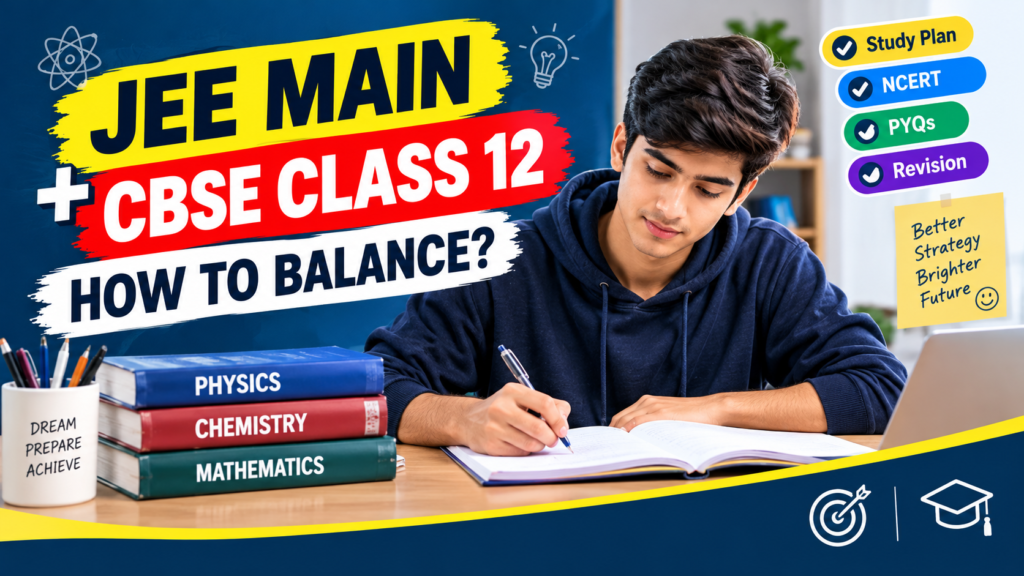
How to Balance JEE Main Preparation with CBSE Class 12 Boards: Preparing for JEE Main while studying for CBSE Class 12 Board Exams can be challenging. Students need to understand Physics, Chemistry and Mathematics concepts, practice competitive exam questions, complete the board syllabus and revise regularly. The good news is that both exams have considerable syllabus overlap, so a well-planned strategy can help students prepare for both without unnecessarily duplicating their efforts.
If you are wondering how to balance JEE Main preparation with CBSE Class 12 Boards, the key is to build strong concepts, use NCERT textbooks effectively, practice different question formats and follow a realistic study timetable.
In this guide, Career Platform explains how Class 12 students can manage school studies, JEE Main practice, revision and mock tests with a practical preparation strategy.
Why Is It Important to Balance JEE Main and CBSE Boards?
JEE Main tests conceptual understanding, application skills, numerical problem-solving and speed. CBSE Class 12 Board Exams assess subject knowledge, written explanations, derivations, numerical answers and presentation according to the prescribed marking scheme.
Although the examination formats differ, studying the common syllabus systematically can support preparation for both examinations.
The main benefits of balancing both preparations are:
- Better understanding of Physics, Chemistry and Mathematics.
- Less duplication of study effort for overlapping topics.
- Improved numerical problem-solving and written-answer skills.
- More consistent revision of important concepts and formulas.
- Better time management during examination season.
Students should remember that a good strategy is not about studying every waking hour. It is about using available study time effectively and maintaining consistency.
1. Understand the Syllabus and Examination Pattern
Before preparing a timetable, review the latest CBSE Class 12 syllabus and the official JEE Main syllabus for your examination year.
Make a chapter-wise list for Physics, Chemistry and Mathematics. Mark each chapter according to its preparation status:
- Strong: Concepts are clear and questions can be solved independently.
- Needs practice: Theory is understood, but problem-solving requires improvement.
- Needs revision: Important concepts, formulas or reactions need another review.
- Not started: The chapter requires structured learning from the beginning.
Also identify chapters that overlap between the CBSE syllabus and JEE Main syllabus. These chapters can often be studied together, although the depth of practice required for each examination will differ.
Always use the latest official syllabus because the prescribed content and examination requirements may change.
2. Use NCERT Textbooks as Your Foundation
NCERT textbooks are particularly important for CBSE Class 12 preparation and provide a useful foundation for several JEE Main topics.
Physics
Read the prescribed theory, understand definitions and derivations, practise numerical problems and review diagrams where relevant. For JEE Main, supplement textbook learning with objective questions and application-based problems.
Chemistry
Study NCERT theory carefully, especially the prescribed reactions, definitions, concepts and tables. Practise numerical problems and objective questions according to the current syllabus.
Mathematics
Understand formulas, conditions and methods before practising questions. Solve NCERT examples and exercises, then progress to JEE Main-level multiple-choice and numerical-value questions.
Important: NCERT alone may not provide enough practice for every JEE Main topic. Use suitable question banks, previous-year questions and mock tests after building your fundamentals.
3. Follow a Realistic Daily Study Timetable
A balanced timetable should include school or coaching classes, board-oriented study, JEE practice, revision and adequate rest. The following is an illustrative schedule for a student who has time for independent study outside regular classes.
| Study session | Suggested time | Activity |
|---|---|---|
| Session 1 | 60 minutes | Revise concepts or formulas |
| Session 2 | 90 minutes | Physics or Mathematics problem-solving |
| Session 3 | 60 minutes | Chemistry theory and practice |
| Session 4 | 60 minutes | CBSE written answers, derivations or sample questions |
| Session 5 | 30 minutes | Review mistakes and plan the next day |
This example provides about five hours of independent study. It is not a compulsory target; students should adjust it according to school hours, coaching commitments, energy levels and current preparation.
On school examination days, reduce the JEE workload if necessary and prioritise the immediate examination. During periods with fewer school commitments, use additional time for weak chapters and timed practice.
4. Prepare Physics for Both Examinations
Physics requires conceptual understanding as well as numerical practice.
For CBSE Boards:
- Understand definitions, laws and derivations in the prescribed syllabus.
- Practise numerical questions with clear working and units.
- Review diagrams, graphs and important relationships.
- Write answers in a structured and readable format.
For JEE Main:
- Practise conceptual multiple-choice questions.
- Solve numerical-value questions.
- Work on identifying the correct formula and applying it efficiently.
- Review mistakes involving calculations, signs, units and concepts.
A useful method is to study a chapter’s theory first, solve board-style questions next and then practise JEE Main questions on the same topic.
5. Prepare Chemistry with a Chapter-Wise Plan
Chemistry includes different types of learning, so your strategy should reflect the requirements of each section in the prescribed syllabus.
Physical Chemistry
Understand the concepts and formulas, practise calculations and maintain a list of recurring errors. Focus on correct units, mathematical steps and interpretation of numerical questions.
Organic Chemistry
Learn reaction mechanisms and the relationships between functional groups where prescribed. Build a reaction-revision sheet and practise identifying products and applying concepts to unfamiliar questions.
Inorganic Chemistry
Study the prescribed NCERT material carefully. Use short revision notes for key facts, trends, reactions and exceptions. Test your recall periodically instead of repeatedly reading the same pages without practice.
For Board Exams, practise appropriate written explanations and numerical solutions. For JEE Main, add objective questions and timed practice.
6. Strengthen Mathematics Through Regular Practice
Mathematics usually benefits from frequent, focused practice rather than occasional long sessions.
A useful chapter routine is:
- Review the theory and important formulas.
- Solve NCERT examples and exercises.
- Practise board-style questions with complete steps.
- Solve JEE Main questions on the same topic.
- Record mistakes and revisit them during revision.
Maintain a formula notebook for topics such as calculus, algebra, coordinate geometry, vectors and three-dimensional geometry, according to the current syllabus.
Do not measure progress only by the number of questions solved. Understanding why a solution works is more valuable than memorising steps without understanding them.
7. Use Previous-Year Questions and Sample Papers Strategically
Previous-year questions can help students understand question formats, difficulty levels and recurring concepts. However, past trends do not guarantee that the same questions or topics will appear in a future examination.
For CBSE Boards:
- Solve official sample papers for the relevant academic year.
- Practise writing answers within the allotted time.
- Follow the prescribed marking scheme where available.
- Check presentation, units, diagrams and intermediate steps.
For JEE Main:
- Solve previous-year questions chapter-wise after learning each topic.
- Attempt full-length mock tests when a reasonable portion of the syllabus is ready.
- Analyse incorrect answers and questions that took too long.
- Practise using the applicable examination duration and interface.
The goal is to turn practice into measurable improvement.
8. Create a Weekly Revision Plan
Revision prevents previously studied material from becoming difficult to recall during examinations.
A simple weekly plan can include:
- Monday to Friday: Study current topics and practise questions.
- Saturday: Revise the week’s Physics, Chemistry and Mathematics chapters.
- Sunday: Attempt a suitable test or sample paper and analyse mistakes.
Adjust this plan around school tests, coaching assessments and board practicals.
Use an error notebook containing three categories: conceptual mistakes, calculation mistakes and questions that could not be completed within the available time. Revisit these entries regularly.
9. Change Your Strategy as Board Exams Approach
The balance between JEE Main and Board preparation should change according to the examination calendar and your current progress.
During the early preparation phase
Build concepts, cover the syllabus systematically and practise both board-style and JEE-style questions. Avoid leaving major topics until the final weeks.
During the middle phase
Increase timed practice, revise completed chapters and identify gaps through tests. Keep board answer-writing practice in your weekly routine.
When Board Exams are approaching
Give greater priority to the nearest Board paper, NCERT revision, official sample papers and written-answer practice. Continue shorter JEE revision sessions where practical, but avoid overloading yourself during the immediate examination period.
After the Board Exams
If your JEE Main session is still upcoming, reassess the remaining syllabus, revise high-priority weak areas and practise timed papers. Follow the official examination schedule rather than assuming a fixed number of days between examinations.
10. Common Mistakes to Avoid
Students preparing for both examinations should watch out for these common mistakes:
- Studying only JEE objective questions and ignoring Board answer-writing practice.
- Memorising formulas without understanding their application.
- Using too many books and study resources at the same time.
- Taking mock tests without analysing the results.
- Ignoring NCERT material relevant to the prescribed syllabus.
- Postponing revision until the syllabus is completely finished.
- Following an unrealistic timetable that leaves insufficient time for sleep and breaks.
- Comparing personal progress with other students instead of tracking individual improvement.
A sustainable routine with regular practice and adequate rest is generally more useful than an extreme schedule that cannot be maintained.
Frequently Asked Questions (FAQs)
1. How can I balance JEE Main preparation with CBSE Class 12 Boards?
Follow a chapter-wise plan that combines overlapping topics, use NCERT for fundamentals, practise JEE Main questions and regularly solve CBSE-style written questions and sample papers.
2. Is NCERT enough for both JEE Main and CBSE Boards?
NCERT is an important foundation for CBSE Boards and many JEE Main topics. However, JEE Main generally requires additional objective practice, numerical problem-solving and previous-year questions.
3. Should I prepare for JEE Main or CBSE Boards first?
Build concepts for both examinations together where the syllabus overlaps. As Board Exams approach, increase the time devoted to Board-specific revision and written-answer practice while adjusting JEE practice to the examination calendar.
4. How many hours should I study daily?
There is no single ideal number for every student. Your schedule should account for school, coaching, current preparation, rest and other responsibilities. Consistent, focused study is more useful than following an unrealistic hourly target.
5. Are JEE Main previous-year questions useful for Class 12 Boards?
They help strengthen concepts and problem-solving, but they do not replace CBSE sample papers, prescribed textbook exercises and written-answer practice.
6. When should I start solving full-length mock tests?
Start with chapter-wise tests as you complete topics. Introduce full-length tests when enough of the syllabus has been covered to make the results useful, and increase their frequency as the examination approaches.
Final Words
Balancing JEE Main preparation with CBSE Class 12 Boards becomes easier when students organise their syllabus, use study time carefully and revise consistently. NCERT fundamentals, chapter-wise problem-solving, Board answer-writing practice and regular test analysis can support preparation for both examinations.
There is no universal timetable that works for every student. Choose a realistic plan, review your progress each week and adjust your priorities according to your upcoming examinations.
Career Platform helps students build conceptual clarity and prepare systematically for IIT-JEE, CBSE Board Exams and other academic goals.
For JEE related updates: Career Platform JEE
Disclaimer: This article provides general study guidance. Students should consult the latest official CBSE curriculum, CBSE sample papers and JEE Main information bulletin for examination-specific requirements.

Pingback: CBSE Date Sheet 2027: 10वीं-12वीं की डेटशीट कब आएगी?
Pingback: How to Score 90%+ in CBSE Class 10 Board Exams 2027 - Career Platform
Pingback: Student Discipline and Study Tips | Career Platform